DN700
Garis Delay Digital
1 / 1
View in fullscreen
DN700
LegacyGaris Delay Digital
About this product
Garis Delay Digital
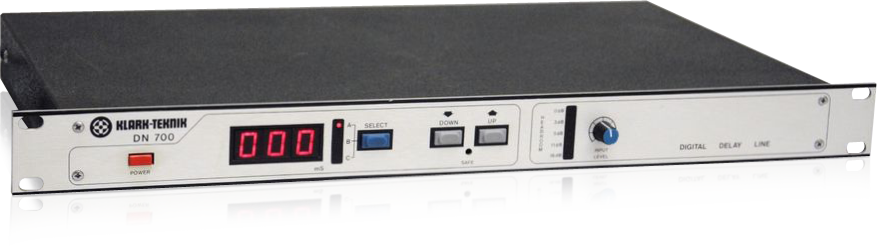
DN700 — Digital Delay Line
The DN700 was introduced in 1984 as one of Klark Teknik's first digital delay lines, a single-input three-output unit that established the architecture later refined in the DN716 and DN7103. It is a historically significant piece of British studio outboard, and its underlying signal-path design — particularly the seven-pole elliptical input/output filters using FDNR circuitry — set the benchmark for low-noise, low-distortion delay processing in its era.
Delay Architecture
One input feeds three independently adjustable outputs. Delay time on each output is adjustable from zero to 434 milliseconds in 26.5 microsecond steps, a resolution well below the threshold of audible position artefact for any practical speaker time-alignment task. Memory settings are retained for a minimum of one year without power.
Signal Path
The audio input uses a differential electronically balanced circuit that is both voltage- and current-balanced, achieving symmetry better than -50 dB from 20 Hz to 10 kHz. Input and output filters are seven-pole elliptical types using FDNR (Frequency Dependent Negative Resistance) circuitry, chosen for optimum distortion and noise performance. Frequency response is 20 Hz to 15 kHz unweighted; dynamic range is better than 85 dB unweighted, better than 90 dB A-weighted.
Application
Touring PA delay-tower time alignment, broadcast monitor delay, vintage studio production, and any application that calls for an early-1980s Klark Teknik digital delay as the specific sonic reference.
Specification Highlights
- One input, three independently adjustable outputs
- Delay 0 to 434 ms in 26.5 µs steps per output
- FDNR seven-pole elliptical input/output filters
- Dynamic range >85 dB unweighted, >90 dB A-weighted
- Frequency response 20 Hz - 15 kHz unweighted
- Differential voltage- and current-balanced input
- 1U rackmount